
 September 4, 2026
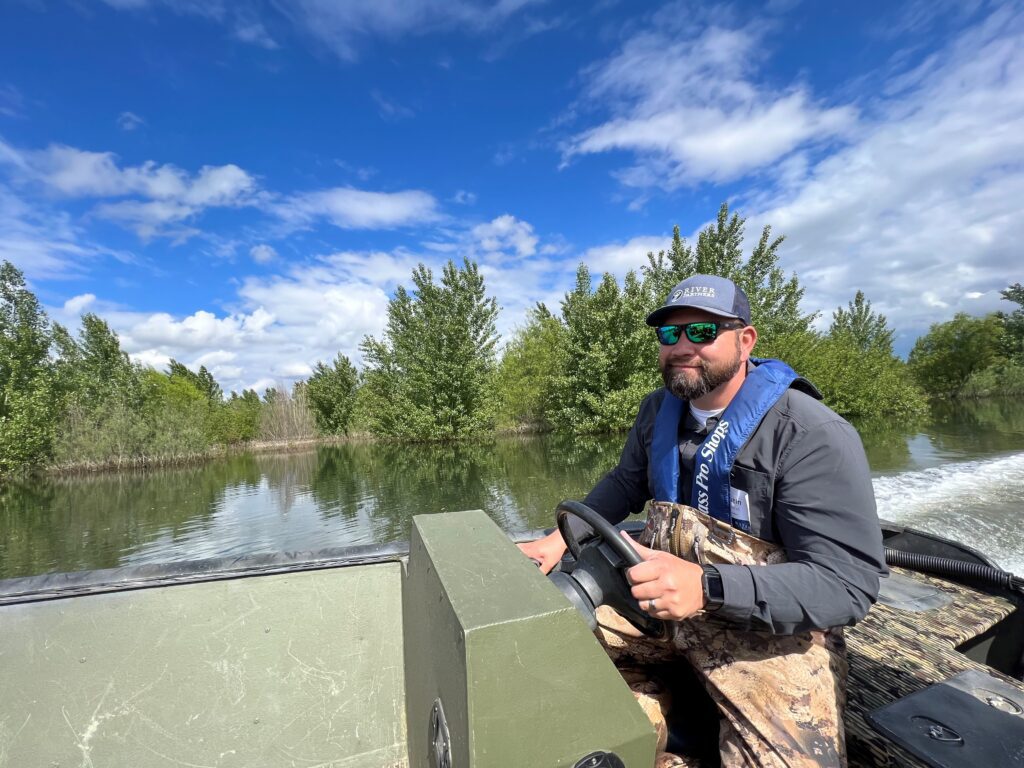
Austin Stevenot spent his first three years at River Partners as an Operations Manager in the San Joaquin Valley. Like the rest of the Central Valley, this region developed nearly all of its native riparian forest in the past two hundred years, and Stevenot is working to help restore lost habitat at a pace and scale that matters.
When Stevenot (Northern Sierra Mewuk) was officially named River Partners’ first Director of Tribal Engagement in 2024, the task in front of him grew from making sure that habitat works for wildlife, people, and communities to ensuring Native voices are not just consulted in our river restoration work, but actively shaping and leading this work.
Much of Stevenot’s energy and focus has been on the San Joaquin Valley and Tulare Basin, where he lives and works. His leadership has been critical in gathering support for River Partners’ Tribal Engagement and Land Guardianship Project, an initiative that invites Tribal voices in the planning and implementation of river restoration in that region.
In his role as Director of Tribal Engagement, Stevenot has shared his unique perspective with thousands of people in the Tribal, NGO, public, and private sectors. Last month, Stevenot co-paneled at World Water Week in Stockholm, Sweden. In his presentation, “Trust and Collaboration as Preconditions for Water Stewardship,” Stevenot talked about his work with California Tribes and what it means to center Tribal voices in restoration and bring them to the forefront instead of relegating them to someone to consult with to check a box.
Stevenot shares his thoughts about his role at River Partners, making good on current state-level conservation and water initiatives, and where they intersect, looking through a Tribal lens.

River Partners is committed to moving from consultation to real co-management with Tribes. What does that shift look like on the ground?
Stevenot: It’s partnerships before anything, bringing in and knowing Tribes before we have a project in their area. It’s having ongoing conversations about our work and how they can be involved, so that when we do have a project, Tribes aren’t trying to figure out who we are and what we do, wondering if we’re trustworthy. It’s about getting Tribes to understand who we are and where we come from and what our true mission is, and that we’ve been doing this for nearly 30 years.
Having those relationships early allows us to write them into grants. It allows them to look at and determine the level that they want to be involved. Do they just want to consult, or do they want to be actively involved in the planning and the maintenance? It gives them more opportunities to work with us. It includes them from start to finish. It builds trust both ways; it builds in us that Tribes put in the effort and time to do the restoration before they eventually take care of it, and that they’re interested in the outcome.
The State Water Board is developing new guidance on designating Tribal Beneficial Uses (TBUs) for specific rivers. What would that designation mean for waterways critical to River Partners’ mission?
Stevenot: I’d like to see them include all watersheds throughout California. Because, as people say, water is life. It flows through the Valley and then California, like blood through our veins. Without it, nothing survives.
We’ve changed the hydrology of this state so badly that I don’t know if we will ever see what was here 100 years ago, but we can at least attempt to expand these floodplains and recharge these aquifers to get the life back that was once here. The TBUs in the end just need to equate to a healthy ecosystem.
I’m often asked, “What would be the best outcome for Tribes in these restoration sites?” And my answer is always, “A healthy ecosystem.” That brings back all levels of life, the insects, the bacteria, everything, which leads to the songbirds and the mammals and the wildlife that have been excluded in the last 100 years from these landscapes. And that’s a representation of our culture, people, languages, and ceremony—it all comes from these landscapes.
So, to be able to have a healthy landscape again and to bring people out to understand why these things are the way they are in our cultures is huge. And TBUs are one tool we can use to ensure healthy landscapes.
California is now funding land returns to Tribes, not just conservation easements. How does that change what’s possible for River Partners’ Tribal partners?
Stevenot: I think if Tribes are interested in these land returns and having them restored, it definitely accelerates the pace of what we’re doing. A lot of Tribes don’t have the capacity or knowledge to do the restoration at this scale, so having River Partners as a partner in this work to preserve these lands is critical.
I keep telling state agencies that it’s great what you’re doing, but where are the endowments? Where’s the long-term maintenance for these Tribes? The California Natural Resources Agency (CNRA) is touting that 7.5 million acres of land will be co-managed by or returned to Tribal communities. While I think that’s a well-intentioned goal, it can end up being a problem.
You’re expecting Tribes to take over a landscape that’s not what we left and not how we left it, that we were pushed out of. It’s changed, overgrown, and mismanaged, and you’re expecting us to be the magic fix for it now. We have a lot of work to do if that’s the case; we have to come in and manually thin and do all these things before we can go back to these management practices that our ancestors used, that our families used 100 years ago, to maintain before we were thrown in prison for lighting a fire or even looking like we were going to.
There needs to be endowments and money for these. You can’t just expect people to take over something, people who have already been marginalized and may not have the funds or capacity to do these projects without making sure they’re funded enough. Let’s look at the whole picture.
CNRA’s 30×30 initiative is built around the numeric goal of protecting 30% of land and coastal waters by 2030. Is that the right way to measure what Tribes want from these landscapes?
Stevenot: It’s different than what our ancestors had, because they very much lived in and amongst it, and modern-day society is separated from it. If you’re not on the landscape every day, paying attention to it, seeing what it needs, you can’t just walk in and make a decision and hope that it all goes well. It becomes harder to manage. We’re talking about millions of acres. How can an agency or group begin to imagine managing that when you’ve been separated from it, when you’re not living on it, when you’re not part of it anymore?
Part of that is the reconnection, part of it is getting the Tribes back out there. But unless it’s their full-time job, will they be able to go out there four or five days a week? And you can’t by any means have the hands-off approach; we’ve seen what that does. It could lead to catastrophic wildfires and watershed degradation.
What would it look like in 5-10 years for the state to have not just funded programs, but genuinely shifted power back to Tribes on these landscapes?
Stevenot: It’s making sure Tribes are well-funded to continue to maintain the landscapes. It’s not just handing it back, but making sure they’re helping to build the capacity within the Tribes to do these things, like building restoration groups or fire practitioners or whatever comes along with management. You can’t just expect people to walk in and already have the tools.
I’d like to make sure the state walks hand-in-hand with Tribal groups up and down the state to make sure that things are being done, that they have the necessary tools, and have the funding they need. It goes back to the fact that it’s great you want to give it back, but where’s the endowment or funding coming from to do this work?
The feds and the state get funding for Cal Fire and forest management and other initiatives. Will some of that funding be shipped over to the Tribal groups to help with maintenance, to have them on the ground doing these practices? If not, I don’t see the reasoning or purposes of it, other than a pat on the back or a feel-good gesture.

What lessons would you want to share with other organizations that are trying to collaborate with Tribes?
Stevenot: Look for ways to support Tribes moving forward, even after the land transfer. Do they need help with the maintenance of that? Do they need help building capacity? How can we make sure that they have financing separate from their own used to run their governments, and to build capacity within their communities?
One thing that gets overlooked is that a Tribe may have a casino, but a lot of that funding goes to building their community, to lifting people out of poverty. I can speak on behalf of my Tribe that we recently regained our federal status. We’re rebuilding our government, we’re doing all these things, but we don’t have the funding or the staff right now to build these programs.
Would we love to have land back? Yes, but how are we going to manage it? How are we going to move forward in that? Every Tribe is different, so you have to look at case by case who’s getting what and how they’re going to manage that.
Can you describe how it feels to actively center Tribal voices and restoration?
Stevenot: It fulfills a part of me I never knew I needed.
Being able to bring people back to a landscape they’ve been excluded from, that our families were forced out of, and being able to bring people back to understand all these things that go along with our culture that they haven’t had the opportunity to learn. It’s more than just sharing the landscape; it’s sharing culture again. It’s reawakening something that was put to sleep, not because we wanted to, but because it was forced upon us, to assimilate, to be separated from these places.
It’s an honor to get to work with River Partners and lead its work, to be in the places and the rooms I’m in. Sometimes I don’t feel like it’s a job. People tell me, “It’s like that job fell out of the sky for you.” And you know what, it kind of did. It’s like I’m meant to be here doing this, and I will never look upon it as something that is to be taken for granted.