
 November 9, 2026
When River Partners brings life back to California rivers, we’re also bringing wildlife back to these restored habitats. Whether it’s right on the water, adjacent to a river, or where we’ve planted native vegetation, seeing wildlife at a restoration site means our restoration is working—and we want to share more proof with you.
To see what our staff have found in the field over the last year, check out the other installments of our “Eyes in the Wild” series here.
Imperial Wildlife Area, Finney-Ramer Unit (Imperial County)
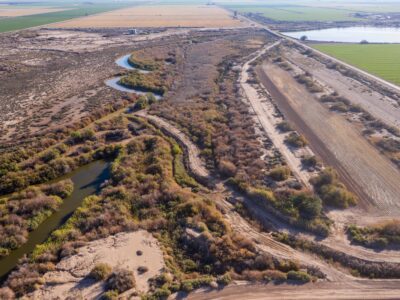
Early morning is a lovely time to walk along the Alamo River in Imperial County. It’s also a great time for these black skimmers to hunt, as seen in this video snapped by Associate Restoration Scientist Maddy Perreault. She caught the action while checking the autonomous recording unit and wildlife camera that were deployed on the Finney-Ramer Unit restoration project we’re leading along with partners from the California Department of Fish and Wildlife (CDFW) and California Conservation Corps.
One of California’s most distinctive waterbirds, the black skimmer is notable for its oversized red-and-black bill. Its diet consists primarily of small, surface-swimming fish, like juvenile tilapia, small desert pupfish, and threadfin shad. The black skimmer flies low over smooth water, mostly during dusk, dawn, and at night when the water is at its calmest. Unlike many other seabirds, the black skimmer can effectively forage in low light or complete darkness, utilizing its lower mandible for tactile feeding as they skim it through the water’s surface. When the lower bill touches a fish, the upper bill instantly snaps shut.
Primarily a coastal species, the black skimmer has established an inland presence in the Imperial Valley. This region—specifically the Salton Sea—is its principal inland breeding and foraging stronghold in North America, nesting in dense, highly social colonies. They prefer low-lying, sparsely vegetated earthen islands, sandbars, and dried mudflats that protect them from ground-based predators like coyotes. Despite healthy and widespread populations in the Americas, the black skimmer is designated as a Species of Special Concern and is fully protected under the federal Migratory Bird Treaty Act.
Panorama Vista Preserve (Kern County)
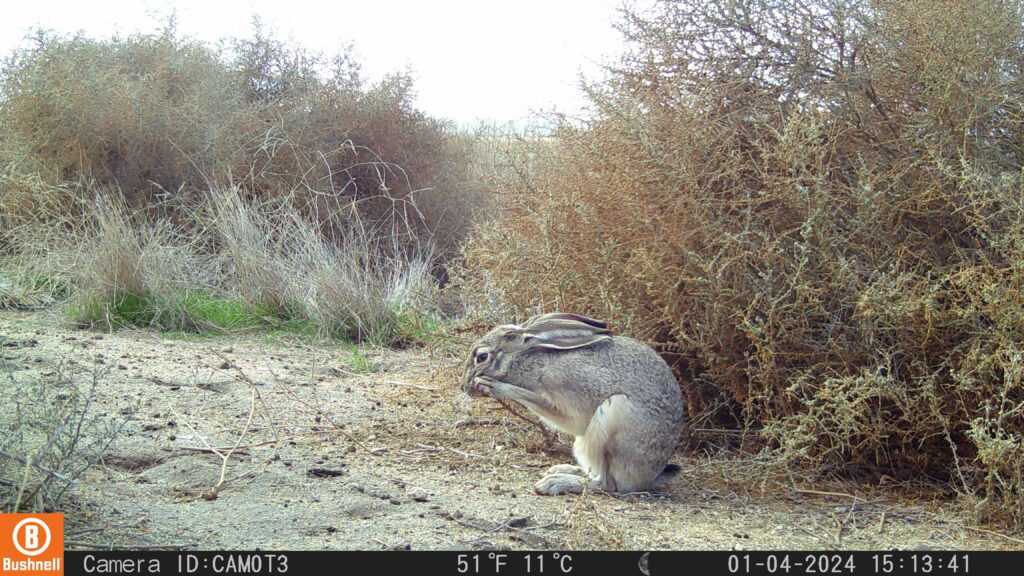
A field camera at River Partners’ 935-acre Panorama Vista Preserve, north of the Kern River in Bakersfield, caught a black-tailed jackrabbit pausing for a grooming session. These jackrabbits live across the Central and San Joaquin valleys and are common in Kern County’s open scrublands, oil field buffer lands, and agricultural margins. Instead of burrowing to escape the valley heat, they rest in shallow depressions under low bushes, called forms, that offer shade and cover from raptors and coyotes. Their long, highly vascularized ears also help shed excess body heat. Black-tailed jackrabbits prefer flat, open country with low shrubs and sparse vegetation, where they can spot predators from a distance and escape on powerful legs at up to 35 miles per hour!
In spring and early summer, these herbivores feed mainly on green grasses, forbs, and wildflowers. In the dry summer and autumn months, their menus switch to woody shrubs, twigs, bark, and cacti. Like other desert-adapted herbivores, they can go long periods without drinking, getting most of their moisture from the plants they eat.
As a keystone prey species in the San Joaquin Valley, they support coyotes, red-tailed hawks, golden eagles, barn owls, and the endangered San Joaquin kit fox. Overall populations remain large and stable, but local populations face habitat loss and fragmentation from agricultural conversion and Bakersfield’s urban expansion. They’re also susceptible to Rabbit Hemorrhagic Disease Virus (RHDV2), a highly contagious and often fatal disease that attacks the liver.
San Joaquin River National Wildlife Refuge (San Joaquin and Stanislaus Counties)

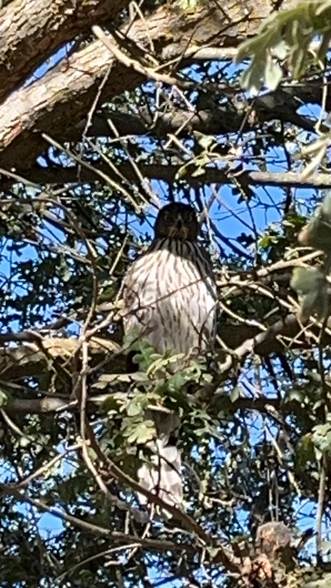
Associate Restoration Scientist Leah Young-Chung was sterilizing traps at the 7,500-acre San Joaquin River National Wildlife Refuge when this Cooper’s hawk swooped under the tree canopy and landed on a branch. Cleaning the traps after each morning’s work helps limit disease spread among the endangered riparian brush rabbits that River Partners humanely traps and vaccinates against RHDV2 in partnership with CDFW, the U.S. Fish and Wildlife Service, Oakland Zoo, and others. River Partners has restored about 2,500 acres of native habitat used by the rabbits at the Refuge.
A medium-sized raptor native to California, the Cooper’s hawk lives year-round across the state, from coastal valleys to elevations around 9,000 feet. These stealthy predators historically lived mainly in dense oak woodlands, conifer forests, and riparian corridors, but they have adapted remarkably well to people. Today they’re common in suburban neighborhoods, city parks, and backyards, often nesting in mature trees.
Short, broad wings and a long, rudder-like tail let Cooper’s hawks weave through dense foliage, as this encounter showed. They typically perch quietly, then burst into short, high-speed chases after medium-sized birds like mourning doves, pigeons, robins, starlings, jays, and northern flickers, as well as small mammals like squirrels, chipmunks, and mice. Backyard bird feeders, with their concentration of birds, are a favorite hunting ground.
Populations dropped sharply in the mid-20th century because of DDT contamination and hunting, then rebounded strongly after DDT was banned. Though not listed as threatened or endangered, the Cooper’s hawk is protected under the federal Migratory Bird Treaty Act and California’s bird-of-prey laws. In California, it still faces threats from collisions with windows and vehicles, secondary poisoning from rat poison, and loss of local forest habitat.
Heritage Growers (Colusa County)
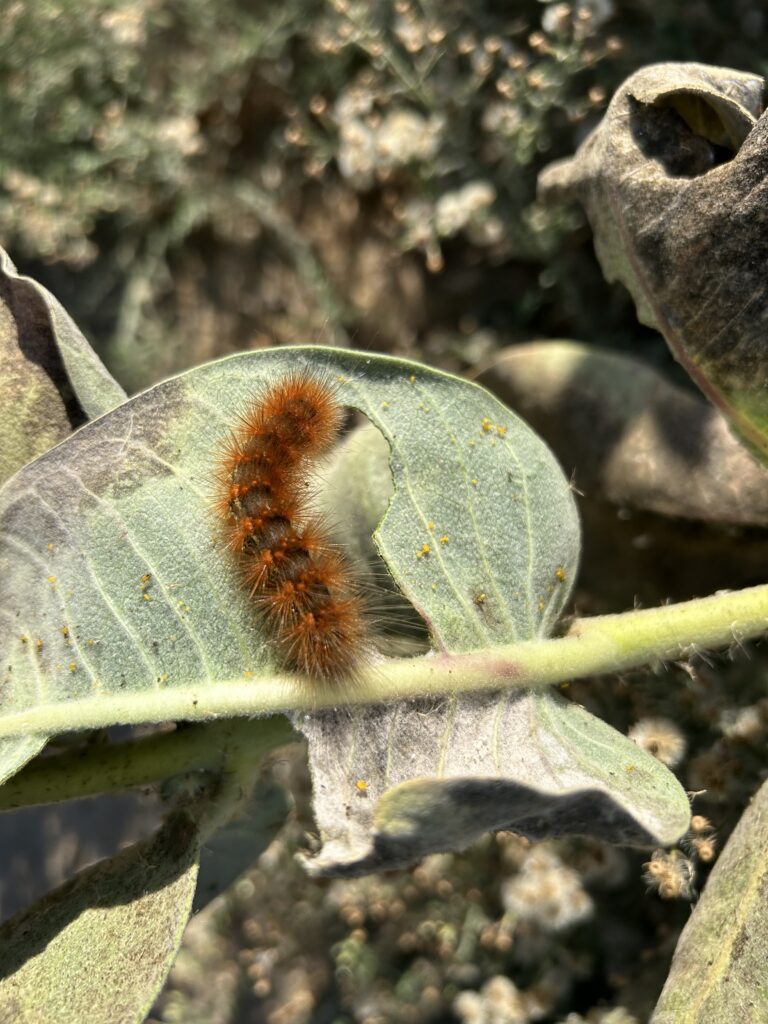
Restoration Scientist Kylie McNary was surveying milkweed for monarch caterpillars at the 240-acre farm at Heritage Growers, our nonprofit native seed venture near Colusa, when she found several salt marsh caterpillars munching away on showy milkweed. These are the larvae of the salt marsh moth, a native tiger moth common across North America. Well-adapted to inland agricultural landscapes, they’re plentiful throughout California’s Sacramento and San Joaquin valleys, where they’ve become an agricultural pest largely because abundant non-native plant species have allowed their population to increase.
The caterpillars are voracious eaters, feeding on all sorts of plant species. Their immunity to many different plant defenses allows them to eat some that are toxic to other insects, like milkweed and peppers. Mature larvae chew large holes through leaves and roam in search of fresh, new greenery. Adult moths drink floral nectar and aphid honeydew (a nice way of saying the sticky, sugar-rich liquid aphids excrete as they feed on plants), and as they move from flower to flower, pollen sticks to their bodies and travels with them, helping pollinate plants.
The Central Valley’s long, warm growing season lets this species complete three to four generations a year, with populations building through late spring and summer. By early to mid-autumn, mature caterpillars are known for short mass migrations in search of food and sheltered spots to spin cocoons for the colder months. While they’re a pest to agricultural operations, salt marsh caterpillars are an important part of the food web: lady beetles, assassin bugs, and parasitic wasps prey on the caterpillars. Adult moths make calorie-rich meals for birds, bats, and spiders. So, like much of the wildlife we see in restored sites, when we see this species, we know the restoration is working.