
 September 15, 2026
This month, a River Partners ecologist found imperiled monarch caterpillars on milkweed she helped plant five years ago. A project partner photographed a songbird nesting in willows we put in the ground two seasons back. A trail camera at one of our restored properties caught a fox and an owl squaring off in the dark.
None of it is luck. It’s revitalized habitat doing exactly what we designed it to do.
Curious what else River Partners is spotting out in the field? Explore more sightings from our “Eyes in the Wild” series here.
Chico Headquarters (Butte County)
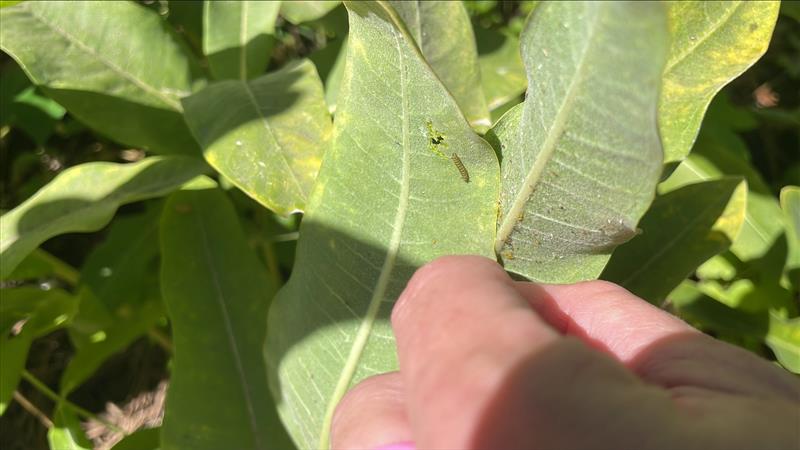

In past editions of “Eyes in the Wild,” we’ve told you about a sighting of the iconic Western monarch butterfly at our Chico headquarters. We’re thrilled to add another chapter to the story: Restoration Science Ecologist April Damanti reported that she found four monarch caterpillars roaming around and chomping on the showy milkweed we planted five years ago in front of our office. These tiny monarch caterpillars started as eggs laid on the underside of milkweed leaves. They’re pictured here in the larval stage, and they’ll grow significantly before forming a jade-green chrysalis. In the meantime, these caterpillars happily munch away on showy milkweed leaves, since milkweed is the only plant monarch caterpillars eat.
For us, seeing these caterpillars anywhere is inspiring. Four decades ago, Western monarchs numbered around 4.5 million. Today, that population has fallen more than 99 percent, driven by habitat loss, pesticides, and climate change—and the window to reverse the trend is narrowing fast.
River Partners has committed to a bold goal: planting 15 million milkweed plants for monarchs across California by 2030. We’ve been planting milkweed for two decades, and we’re now greatly increasing that effort, while also working with researchers to learn critical details, like how much milkweed is needed in the Central Valley, and how close together the plantings need to be for butterflies to use them.
Our nonprofit native seed venture, Heritage Growers, is supplying seeds and plants for most of this effort.
Future Restoration Site (Central California)

While checking out one of our future Central California restoration sites, our Science staff stopped long enough to admire this striking flame skimmer, a type of dragonfly, perched on a twig. Like many dragonfly species, flame skimmers possess brilliant coloring—this one has a glowing orange-red coloration across its body, wings, and veins.
And like all dragonflies, flame skimmers are voracious, opportunistic predators at each stage of their lifecycle. When they’re aquatic nymphs, they feast on aquatic prey, like mosquito larvae, small aquatic crustaceans, and tadpoles. As winged adults, they hunt a wide variety of flying insects, including mosquitoes, flies, gnats, and small moths.
We know this is a mature insect due to its fiery red coloration, and males frequently use prominent perches, exposed twigs, or reed tips as base camps, often returning to the same spot after darting out to chase off rival males or snap up passing flying insects. It’s a territory thing. Dragonflies will also assume this exact posture to either warm up their flight muscles on cool mornings or deflect intense midday heat by minimizing the surface area exposed to direct sunlight.
Hidden Valley Ranch (Stanislaus County)

One of our trail cameras captured a gray fox on its nightly stroll at our 350-acre Hidden Valley Ranch restoration project just west of Modesto along the San Joaquin River. And in the background, a great horned owl watches. Both notice and are wary of each other.
Some inter-species interactions are mutually beneficial (remember the coyote and badger hunting together in Imperial County?), tolerated, or merely ignored—this is not one of them. The owl’s wide-eyed, fixed stare indicates it is fully locked onto the fox, seeing it as a potential threat or rival, not a friendly neighbor.
The gray fox finds its home across brushlands, chaparral, oak woodlands, and riparian corridors. In the Central Valley, they like dense brushy understories, dry creek beds, and agricultural or orchard edges with abundant cover and accessible prey. Their diet shifts with the seasons—primarily hunting small mammals like cottontail rabbits and rodents —and they also eat insects, birds, and all kinds of native fruits and berries. Meanwhile, the great horned owl, a powerful apex hunter, will occasionally prey on small mammals or kit foxes. A full-grown gray fox, however, is probably too large to be regular prey, so aggressive behavior toward each other when their paths cross is usually on the menu instead.
Rancho Breisgau (Shasta County)
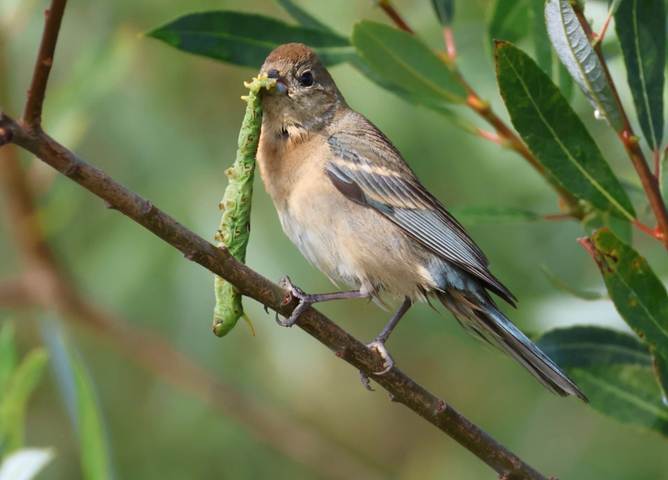
Evidence that our restoration is working can come from first-hand sightings or sometimes with an assist from technology. Other times, it’s from a project partner, like in the case of this photo of a lazuli bunting. This summer, Tobias Felbeck, a U.S. Bureau of Land Management (BLM) Wildlife Biologist, was conducting a bird survey at our 300-acre Rancho Breisgau restoration project along the Sacramento River north of Red Bluff, monitoring bird diversity on land we restored that BLM owns. Observing about a dozen breeding pairs of lazuli buntings nesting in the early successional willow habitat River Partners planted two years ago, Felbeck snapped this photo—evidence that wildlife is returning to restored habitat.
Part of the cardinal family, the lazuli bunting is a migratory songbird and lives in semi-open brushy areas, chaparral, and grassy hillsides, particularly near water sources like streams or rivers. This one was spotted adjacent to the Sacramento River proudly holding a white-lined sphinx moth caterpillar. During the spring and summer breeding months, insects—particularly caterpillars, grasshoppers, beetles, and spiders—make up more than half of their diet, providing critical high-protein nutrition for foraging adults and their nestlings.
Female lazuli buntings build the nest from grass, weeds, bark, and leaves, and line it with fine grasses and plant roots. It’s typically placed between two and four feet high in a dense fork of a shrub, briar patch, or low tree. The female lays a clutch of three to four pale bluish-white eggs, which she incubates alone for up to two weeks. Both parents chip in to feed the nestlings.
To thrive, lazuli buntings require healthy corridors of dense shrubs, brushy edge habitats, and open patches for foraging. Despite stable and healthy populations, habitat fragmentation, overgrazing in riparian zones, and the removal of native understory brush still pose local threats to their breeding grounds.