
 September 22, 2026
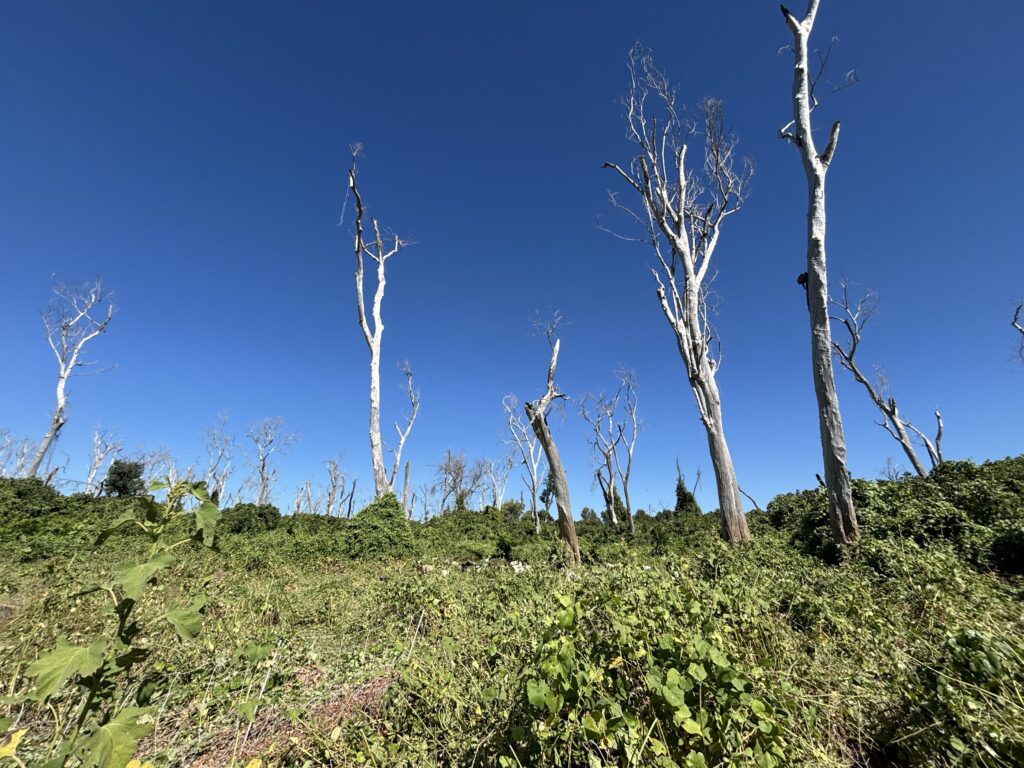
A 2022 wildfire tore through a small cottonwood forest within the Sacramento River Wildlife Area’s Colusa South Unit, near the farming town of Colusa, a 45-minute drive north of Sacramento. What grew back was worse than what burned: a dense tangle of Himalayan blackberry and grape vine, choking out the riparian plants that once thrived there and building up exactly the kind of fuel load that feeds the next fire.
This summer, River Partners and the California Department of Fish and Wildlife (CDFW) sent in a different kind of crew: nearly 400 Boer goats, trucked in from Santa Rosa, that grazed, chewed, and chomped their way through 40 acres of invasive growth. River Partners plans to replant the site with native vegetation, but the tangle had to come down first. It was so dense that members of our science team couldn’t even get in to assess the land underneath it.
Goats are one of the more unconventional tools in River Partners’ restoration work, but a practical one. Targeted grazing clears invasive fuel with a fraction of the ground disturbance of heavy equipment, and without the herbicides that can affect water quality and wildlife in a sensitive river corridor.
Once a Mature Forest, Now a Wildfire Risk
The SRWA’s Colusa North and South units (sitting just north of the farming community of Colusa, population about 6,500) were ripe for treatment. In 2024, CDFW worked with River Partners on a Vegetation and Wildlife Assessment here, which determined that the Sacramento River Wildlife Area Colusa North and Colusa South Units should be prioritized for wildfire risk reduction
“The overall purpose of the current project is to remove highly flammable and dense invasive species and replace them with wildfire-resilient and pollinator-friendly native plants,” CDFW Wildfire Resiliency Coordinator Julie Garcia said.
“At one time, Colusa South was a mature cottonwood forest, with an understory of riparian shrubs and smaller trees, like ash, elderberry, box elder, and willows,” said River Partners Senior Scientist Dr. Sarah Gaffney.
Altered hydrology and the subsequent lack of natural flooding changed the natural and valuable disturbance and hydrologic regime. As a result, native grape was no longer kept in check as it would be in a healthy riparian ecosystem, and it grew unencumbered, reaching up to the 40-foot-high cottonwood canopy.
“In 2022, an accidental spark nearby caused a fire and the Colusa South Unit burned,” Gaffney said. “The grape vines acted as ladder fuel that went into the canopy and killed the cottonwood forest and likely other vegetation.”
Since the blaze, the fields have become overgrown again with poison oak, fig, and blackberry, with grape vines climbing back into the cottonwood snags. Before River Partners could assess the area for revegetation, it had to be cleared.
Meet the Goats
Chasin Goat Grazing, LLC is a family-owned business, co-owned by husband-and-wife team Chase and Emma Cianfichi. It has provided vegetation management services for individuals, businesses, and government agencies since 2015.
“Rather than relying entirely on herbicides, chainsaws, or heavy equipment, we use goats and sheep in areas where they can be especially effective,” said Chase Cianfichi. “We want to help landowners create healthier, more fire-resilient landscapes while reducing the environmental impact.”

An electrified fence of moderate voltage sets the goats’ perimeter, while a shepherd monitors them around the clock; when they finish in one area, the fence gets moved to the next. Huge, downed limbs crisscross the steep hills and uneven terrain here, but that’s no obstacle for this crew. Goats can reach steep, rocky, or difficult-to-access areas that would be more challenging, expensive, or hazardous to clear by hand or machine, with minimal ground disturbance.
“This location is ideal for utilizing prescribed herbivory given the large amounts of green vegetation, coarse woody debris from fallen trees, potentially steep slopes under the vegetation, and the ability to control impacts on soil and sensitive species in the area,” Garcia said.
Grazing can also increase vegetation diversity and encourage native species, working with natural processes rather than against them.
“It can reduce the need for herbicides and emissions-producing machinery,” Cianfichi said. “Instead of removing vegetation and hauling it away, the goats naturally consume it and return nutrients to the soil.”
By the time the goats arrived this summer, the grape vine was back up to 6 feet high in places, posing safety risks for River Partners staff and preventing them from properly assessing the site for future restoration.
“The goats definitely helped with this, grazing it down to a more manageable 1-2 feet tall,” Gaffney said. “If the vegetation wasn’t cleared, the grape would likely continue to grow, not allowing other native species to expand. Now we can better assess the site and see where flooding occurs and at what depths during the winter, and which sections lack other species and would require replanting.”
Saving Sensitive Species One Mouthful at a Time
Dense invasive brush and dried weeds create fuel loads along river corridors, while regulatory and community pressure to avoid herbicide use near active waterways continues to grow. By reducing fuel loads this way, River Partners is creating a more fire-adapted landscape naturally near sensitive fish and riparian habitat.
“Herbivores are essentially a biological masticator that can turn unwanted biomass into a consumable product,” said Garcia. “In addition to fire prevention benefits, carefully managed grazing can provide important environmental benefits such as increased soil organic matter, control of invasive species, and improved plant and wildlife habitat.”

Many threatened and endangered wildlife species make their home in these riparian forests, sandy banks, and aquatic habitats, from salmon runs and the Valley elderberry longhorn beetle to the bank swallow and more elusive species like the ringtail and porcupine. This gentler removal method poses less risk to species that can’t tolerate heavy equipment or chemical exposure. It also clears the way for native plant communities to return and aligns with River Partners’ broader riparian forest restoration goals.
Cianfichi said working with River Partners has been rewarding because of the shared goals.
“River Partners focuses on restoring healthy river ecosystems and creating habitat for wildlife, while we bring our livestock and grazing expertise to help manage vegetation on the ground,” he said. “What I appreciate about working with River Partners is that they look at the bigger picture. Their work brings together conservation, agriculture, and practical land management, which makes targeted grazing a natural fit.”