
 November 7, 2025
In collaboration with the U.S. Fish and Wildlife Service (USFWS) and Pacific Gas and Electric Company (PG&E), non-profit restoration organization River Partners has launched a 106-acre habitat restoration one mile southwest of Caswell Memorial State Park that will transform former irrigated cropland into a diverse, self-sustaining native ecosystem to support some of California’s most imperiled wildlife.
Located on the south side of the Stanislaus River west of Modesto in Stanislaus County, the restoration site is a vital piece to the larger habitat mosaic in the region. The site sits on USFWS-owned land adjacent to nearly 40 acres of previously restored land and home to a notable population of the federally and state-threatened riparian brush rabbit. It is also across the Stanislaus River from Caswell Memorial State Park, one of the last remnants of Central Valley riparian forest comprised of mostly native trees and plants in the San Joaquin Valley.
Restoring this segment will strengthen regional biodiversity, improve climate resilience through natural carbon sequestration, and provide essential corridors for wildlife movement by expanding one of the largest contiguous riparian corridors in the San Joaquin Valley. Once complete, this will stand as a model of how collaborative, public-private restoration can achieve meaningful, landscape-scale conservation for California’s most at-risk species.

“Without partnership, projects like this wouldn’t be possible,” River Partners Restoration Science Ecologist Haley Mirts said. “We can do the work of planting and tending, but we need land conservators like the USFWS and funders like PG&E to come together to make the project successful.”
Restoration efforts are designed to support three key native plant communities—oak woodland, rose-briar thicket, and grasslands with seasonal wetlands—to provide vital food, cover, and nesting habitat for threatened species including:
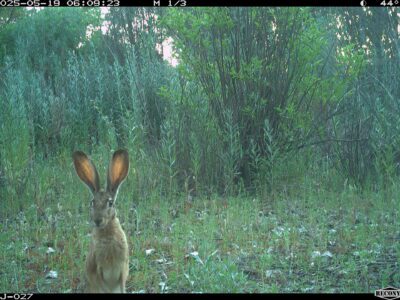
- Riparian brush rabbit (RBR): The site provides an expansion of nearby known RBR habitat, with a newly constructed one-acre “bunny mound” offering high-ground refuge and food sources during extended periods of flooding.
- Valley elderberry longhorn beetle (VELB): More than 1,100 elderberry shrubs will be planted to extend existing beetle habitat and support population recovery.
- Tricolored blackbird (TRBL): Grassland strips with a seasonal swale planted with diverse flowering plants will support foraging for insects during their nesting season.
- Western monarch butterfly: Restoration will help advance pollinator recovery with the planting of more than 4,000 native plugs, including narrowleaf milkweed, marsh baccharis, and goldenrod, enhancing foraging and egg-laying habitat for the Western monarch butterfly and other crucial pollinators.
Partnerships power these restoration efforts. Funded by PG&E as part of its environmental mitigation commitments, the project exemplifies strong, multi-sector collaboration and reflects a model of proactive and collaborative conservation.
“We believe this restoration project is a significant step in our commitment to environmental stewardship in the San Joaquin Valley,” said PG&E Principal Program Manager of Environmental Resources and Mitigation Matt Brown. “By partnering with River Partners and the US Fish and Wildlife Service, we’re supporting vital ecosystem restoration for several threatened or endangered species. And, this project exemplifies how public, non-profit, and private collaboration can create lasting positive impacts on our environment that benefit our hometowns and customers.”
After site preparation was completed in September, planting of native vegetation begins this month and is expected to wrap up in February 2026.
After planting native vegetation is complete, River Partners will monitor and maintain the site for three years. And as land manager within the San Joaquin River National Wildlife Refuge, the USFWS will overseeing long-term habitat stewardship.
“This important work is consistent with the long-term conservation plan for the Refuge, and USFWS appreciates the efforts of our conservation partners to recover threatened and endangered species and enhance habitat for migratory birds and resident wildlife species,” USFWS Project Leader Chris Harper said. “We appreciate the leadership of River Partners and PG&E in developing successful private-public partnerships that result in positive conservation outcomes for fish and wildlife populations.”