
 May 27, 2026
California has a bold restoration goal to save its wildlife, restore its habitat, and increase climate resilience—and using native seed plays a key role. Yet, restoration-quality native seeds aren’t always widely available, prices can be unsustainably high, and demand far outpaces supply, causing a major bottleneck in large-scale ecological restoration.
This is why in 2023, the California Wildlife Conservation Board (WCB) awarded funds for a project sponsored by River Partners and Heritage Growers Native Seed and Plant Supply, a nonprofit program of River Partners. The purpose of the sponsored program was to strengthen the supply of restoration-quality, source-identified native seed by learning where to collect and how to grow and amplify native seed for River Partners’ restoration projects in the San Joaquin Valley and Tulare Basin.
As part of a $40 million grant for restoration planning, research, and Tribal engagement across the San Joaquin Valley and Tulare Basin, WCB’s investment in Heritage Growers’ Native Seed Research & Development (Native Seed R&D) project invests in the very future of this region. This funding helped Heritage Growers’ work to collect native seed from the wild and grow them out at the 208-acre Heritage Growers farm near Colusa to help alleviate the native seed bottleneck.
Restoring California Begins with Native Seed
The San Joaquin Valley and Tulare Basin are highly altered landscapes. With a fraction of their historic native ecosystems remaining, 95% of riverside habitat has been lost in the past 200 years. What remains serves as critical lifelines for imperiled wildlife and biodiversity, while also holding native seed for restoration.
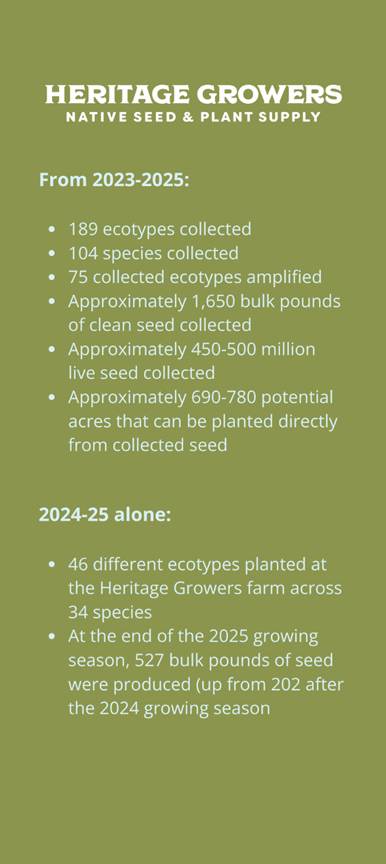
Over the last two years under the Native Seed R&D grant, Heritage Growers scouted wildland collection locations across California, collected those seeds, and amplified them on the farm. Wildland seed collecting can be slow, painstaking, and expensive—and no two years look the same. Weather swings change what grows, when it flowers, and how much seed can be ethically collected. Plus, additional challenges of working within short collection windows, coupled with unpredictable seasons and weather whiplash, make a difficult task even harder.
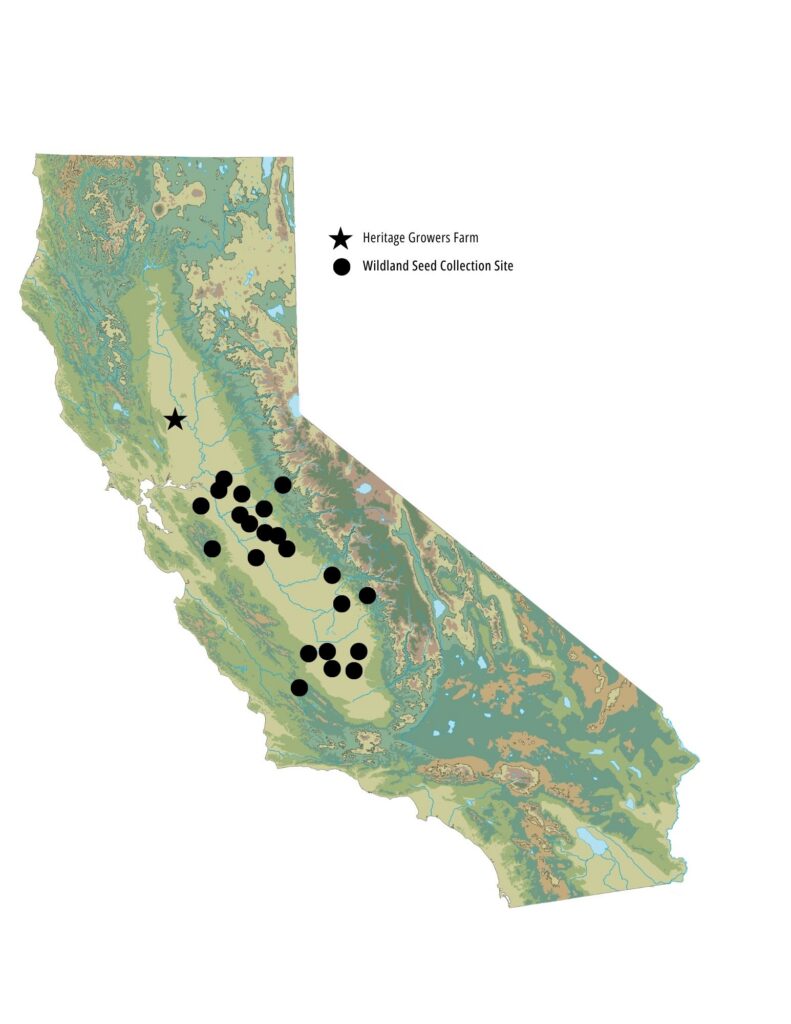
In restoration, the source of native seed also matters: The native seed that California needs cannot be bought in the aisles of a hardware store. Locally adapted versions of a species (called ecotypes) tend to establish and persist better than non-local seed. And over the last two years, Heritage Growers’ collection team worked to gather seed from as many places in the San Joaquin Valley and Tulare Basin as possible.
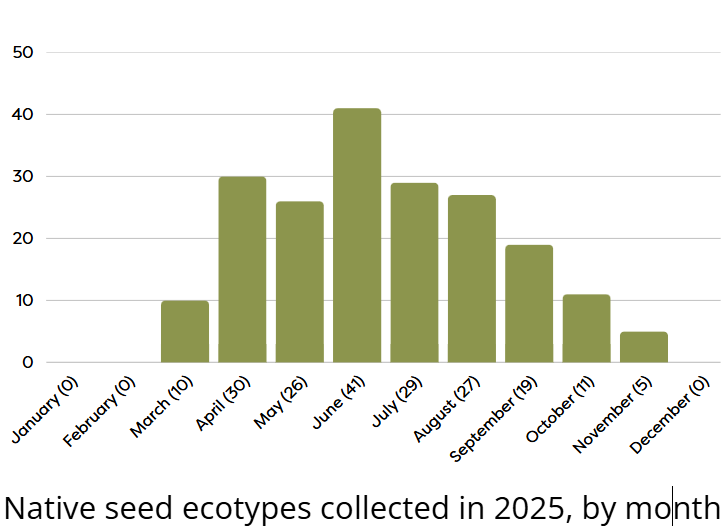
Collecting wildland seed is a year-round endeavor. Scouting for potential locations can happen most any time of year, noting the plant’s location, who to get permission from, and when the seeds will be ready to collect ethically (collecting enough wildland seeds to preserve the long-term health, genetic diversity, and natural regeneration of the local plant population on the farm, while leaving enough seeds behind to sustain local wildlife ecosystems). Not to mention the unpredictability of weather: A few unseasonable hot days can push seeds to ripen faster, and cold, wet weather could slow down seed ripening.
Collecting specific wildland seed to amplify for restoration and land retirement projects throughout the San Joaquin Valley and Tulare Basin is critical to the future success of this region. Each species was collected knowing that they all play a vital role in restoring habitat here, while also providing necessary food and refuge sources for the native wildlife. The three most frequently collected species over the last two years were:
- Creeping wild rye: Helps with erosion control and can provide important missing grassland habitat for grassland birds (which are in decline) while also keeping out weeds and reducing soil loss during flood events
- Stinging nettle: Supports biodiversity, hosts insects that feed migratory songbirds and support butterfly populations, and is proven to grow well (it’s not experimental)
- Alkali heliotrope: Tolerant of tough soil conditions (salinity and pH), is widely used by pollinators, and is collected as part of large-scale restoration efforts for the San Joaquin desert ecosystems of the Tulare Basin
Over the past two years, Heritage Growers has grown more than 50 ecotypes at the farm under the Native Seed R&D grant. Because there’s no native seed farming playbook for our teams to follow, each ecotype gets trialed through planting, weed management, irrigation, and harvesting methods in a small plot. Then, we take what we’ve learned to a larger field the next year, which improves the success of native seed farming.
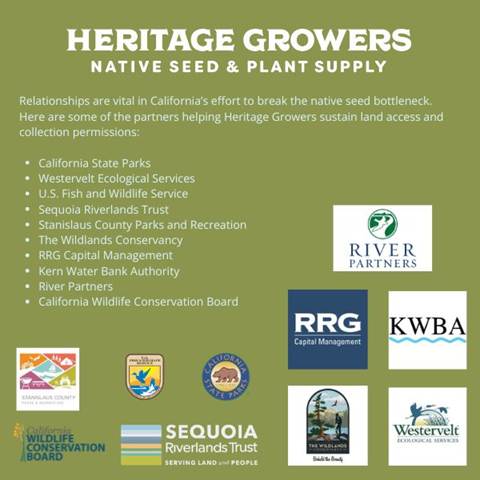
Meeting California’s demand for reseeding also means building long-term partnerships with landowners statewide to ensure continuous access to wild seed sources. Heritage Growers needs a robust supply of seed in cold storage to plant amplification fields—because moving from wild collection to amplification to a viable product can take up to three years.
Additionally, Heritage Growers is currently planning to have enough seed available when more than 5,000 pounds of seed for River Partners projects in 2027 alone are anticipated. This seed could be amplified even more to supply product for other habitat practitioners, benefiting not just River Partners, but also others working to restore California. These are more reasons why the team invests in landowner relationships and carefully documents where species grow, how to access sites, and when to monitor for collection windows.
Seed Research & Development: Top Takeaways
So, what did Heritage Growers learn from two years of scouting, collecting, and amplifying native seed for restoration projects in the San Joaquin Valley, Tulare Basin, and beyond? Well, aside from knowing that 27,000 square miles is a lot of ground to cover…
A floodplain comeback is within reach
Along with River Partners, Heritage Growers is providing seed for 6,000 acres of shovel-ready floodplain restoration projects throughout the San Joaquin Valley—known as our SJ10 projects. Projects that include ready-to-implement restoration plans are quickest to turn funding into action.
Access to more scouting was a huge win
In 2025, Heritage Growers expanded its scouting permissions in the Valley by about 2,600 acres, bringing the total to roughly 18,000 accessible acres across the two seasons we had WCB support. Additional access means more seed-scouting and collection options, which are vital when weather, timing, and plant populations don’t always cooperate.
Rain, or lack thereof, delivered a warning sign
Kern County received 51% less rain in 2025 than in 2024, and nearly 42% less than the historical average. We also saw a sharp drop in goldenbush survival here. And the wildflowers at the Carrizo Plain—known for its eye-popping “super blooms”—remained largely dormant in 2025, with San Luis Obispo County rainfall down 48% year over year.
Heritage Growers’ seed collection team still delivered
Even through less-than-average rainfall, Heritage Growers’ seed collectors brought in wildland seed for 98 ecotypes (70 species) from 26 sites across five counties in the San Joaquin Valley, Tulare Basin, and beyond. Merced County emerged as a seed diversity hotspot, with 63 species identified during scouting and 46 ecotypes collected—including 22 species gathered at the San Luis National Wildlife Refuge Complex alone!
Some of the most valuable results are the ones that didn’t pan out
You win some, you lose some—and either way, you learn. In our case, four ecotypes new to us failed in amplification trials. But that’s why we do the trials, and it underscores why we document even when things don’t work.
By themselves, each of these takeaways is noteworthy and helped propel Heritage Growers’ mission to provide native seed ecotypes to help restore California. But with the Native Seed R&D grant’s support, these lessons lifted Heritage Growers over the expensive and time-consuming hurdle of dialing in wildland seed collection and amplification techniques and developed a diverse inventory of stock seed that will be a resource for all restoration efforts over the years to come.

The Future of California Restoration and Conservation
Heritage Growers is laying the groundwork to break the native seed bottleneck. And our work has been spotlighted by major news outlets and agencies from Bloomberg and Reasons to be Cheerful to The Guardian and the U.S. Fish and Wildlife Service. And while we’re thrilled seeing this support and sharing our story, we are more vigilant than ever to continue the work.
Heritage Growers is planning now for lasting statewide impact. Every day, our teams continue building a diverse seed inventory. Our team of contracting partners is growing steadily—including with the National Parks Service, California State Parks, Stanislaus County Parks and Recreation—and dozens more.
The native seed bottleneck won’t be solved in a single growing season, or even a single grant cycle. But with growing seed inventory, expanding partnerships, hard-won knowledge of how to farm native seeds, and critical support from partners including the Wildlife Conservation Board, Heritage Growers will keep building the foundation of seed for restoration projects across the Valley for years to come.
The goal, ultimately, though, isn’t for this work to be visible. If restoration succeeds, you won’t think about the years of scouting and collecting, the failed trials, and the trial and error that made it possible. You’ll just pull over on a valley road because grasses swaying in the wind caught your eye, or you’ll stand on the edge of a vernal pool flush with wildflowers to admire the beauty. And that’s the only credit we need.