
 December 4, 2025
As our Science and Operations staff continue their tireless work around the state to bring life back to degraded riverways, ecosystems, and communities, they’re coming across rebounding wildlife everywhere. Whether it’s touring restored landscapes in the Sacramento Valley with new staff, helping our Restoration Scholars see first-hand the impact of our restoration efforts around the state, or a surprise discovery of an endangered mammal coming back from the brink, our staff are on the front lines of helping to build biodiversity, ecosystem, and climate resilience throughout California.
Want to learn more about what our staff are seeing in the field? Check out our other installments of our “Eyes in the Wild” series here.
Colusa Bend (Colusa County)

Senior Restoration Science Ecologist Jennifer Rotnem was leading a pair of new Science staff on a site tour at Colusa Bend, a future restoration site of ours along the Sacramento River in Colusa County, when they all saw a flock of Rio Grande turkeys crossing a levee with the majestic Sutter Buttes in the background.
The Rio Grande turkey is one of three main wild turkey subspecies found in California and is most common in the northern and central parts of the state. Introduced in the mid-20th century to help boost wildlife diversity and increase hunting opportunities, they have flourished here, an area resembling its native Southern Plains habitat, thriving in oak woodland and savanna landscapes, riparian corridors along rivers and creeks, grasslands, foothill shrublands, cropland, and even suburban environments. However, as with most introduced species which flourish in the wild, there is growing concern about the turkey’s impact on the native biodiversity of California, and more research is needed.
These birds are omnivores and will eat acorns and seeds, insects, and small vertebrates. They roost at night, often near or along creeks or river corridors. Thanks to an abundance of open ground for foraging and riparian zones for roosting in Northern California (like Colusa County), the Rio Grande turkey population is strong, and, depending on where you live, these adaptable birds may have made themselves at home in your neighborhood and/or refused to back down from your vehicle while you’re driving.
G Ranch (Merced County)

Sometimes our staff capture wildlife in moments of flight, moving swiftly on the ground, or swimming gracefully through water. And sometimes, like this raccoon peeking into a camera trap at G Ranch, our 634-acre restoration site about 10 miles southwest of Merced, these moments just make us smile.
Raccoons are abundant along waterways like riverbanks, sloughs, flooded fields, irrigation ditches, and wetlands. The tree cover and water access of restored riparian corridors provide ideal refuge, cavities for dens, and foraging sites. But the creative and adaptable racoon also uses barns, culverts, and attic spaces as artificial dens. They’re primarily nocturnal and solitary and are true omnivores, preying on animals that live in the water and on land, as well as fruits and nuts and human-associated food, like pet food, compost, and garbage. Because they can transmit disease, please avoid feeding or handling them.
Ecologically, raccoons play a dual role. While they benefit humans by eating pests (like rodents and insects) and disperse seeds via fruit consumption, they also prey upon ground- and shrub-nesting birds, including imperiled riparian species, and can impact amphibians and turtle nests when available.
Riparian restoration efforts benefit meso-predators like raccoons by creating high-quality habitat and prey resources. This isn’t inherently bad—raccoons are part of healthy ecosystems—but their numbers can spike in agricultural landscapes that are being transformed into riparian habitat. In California, raccoon populations are stable or increasing, aided by human-modified landscapes and abundant food sources.
Grayson Riverbend Preserve (Stanislaus County)

Associate Restoration Scientist Bella Cardenas was helping Restoration Scholar Jaredth Thor as he collected data for his fellowship project. He was comparing the density of milkweed planted by River Partners at Grayson Riverbend Preserve along the San Joaquin River near Modesto with that at Panorama Vista Preserve near the Kern River in Bakersfield. River Partners restored this nearly 300-acre area in 2022, adding to the constellation of restored sites across many thousands of connected acres in Stanislaus County. Cardenas saw this male native bee sleeping in a gumplant flower. Identifying bee species can be a multi-pronged approach, including examining all around their bodies, so our Science staff simply called this slumbering fellow a native bee.
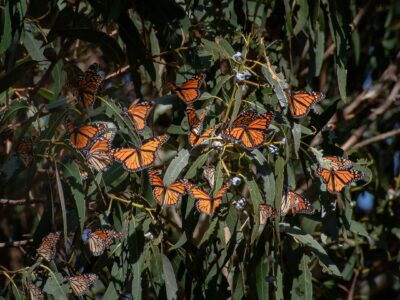
Because male bees leave the nest permanently after emerging, they are tasked with finding shelter and will often sleep in flowers, which provide a sheltered place to rest, especially within those that close at night for an extra layer of safety. Getting some shuteye in flowers can also be a warm place to nap during the day and the bumblebee can start foraging for nectar and pollen for energy as soon as they wake up. Bumblebees can be especially attracted to gumplant, which are rich in these energy sources for their long day of pollen-collecting. River Partners has a goal to increase the number of pollinator-friendly plants for our imperiled bee friends, the Western monarch butterfly, and other pollinators by adding 15 million milkweed plants across California by 2030.
San Joaquin River National Wildlife Refuge (San Joaquin and Stanislaus Counties)

Restoration Science Ecologist Ashley Verna was helping a team of conservationists from the California Department of Fish and Wildlife, U.S. Fish and Wildlife Service, and Oakland Zoo to check traps set out for the critically endangered riparian brush rabbit (RBR) at the San Joaquin River National Wildlife Refuge. A mere 5% of the RBR’s historic habitat remains, some of which is within the 7,500-acre refuge, where River Partners has restored around 2,500 acres of native habitat.
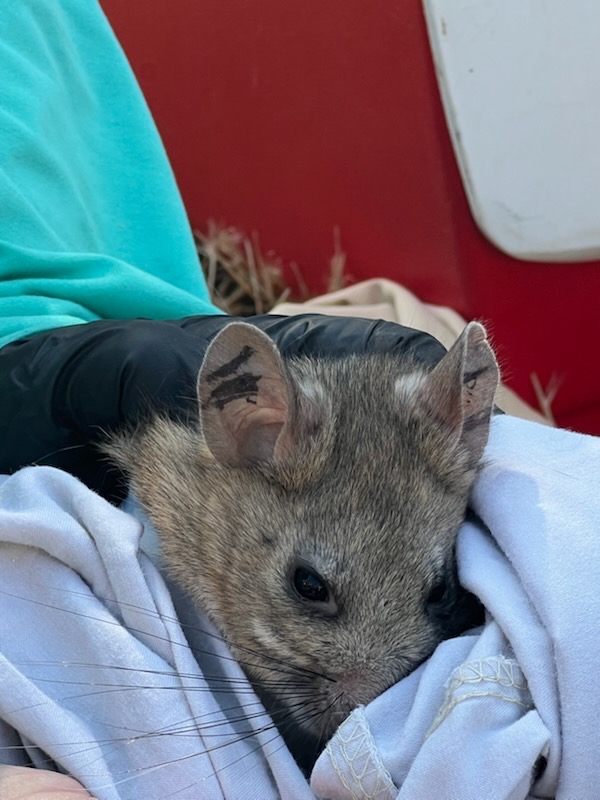
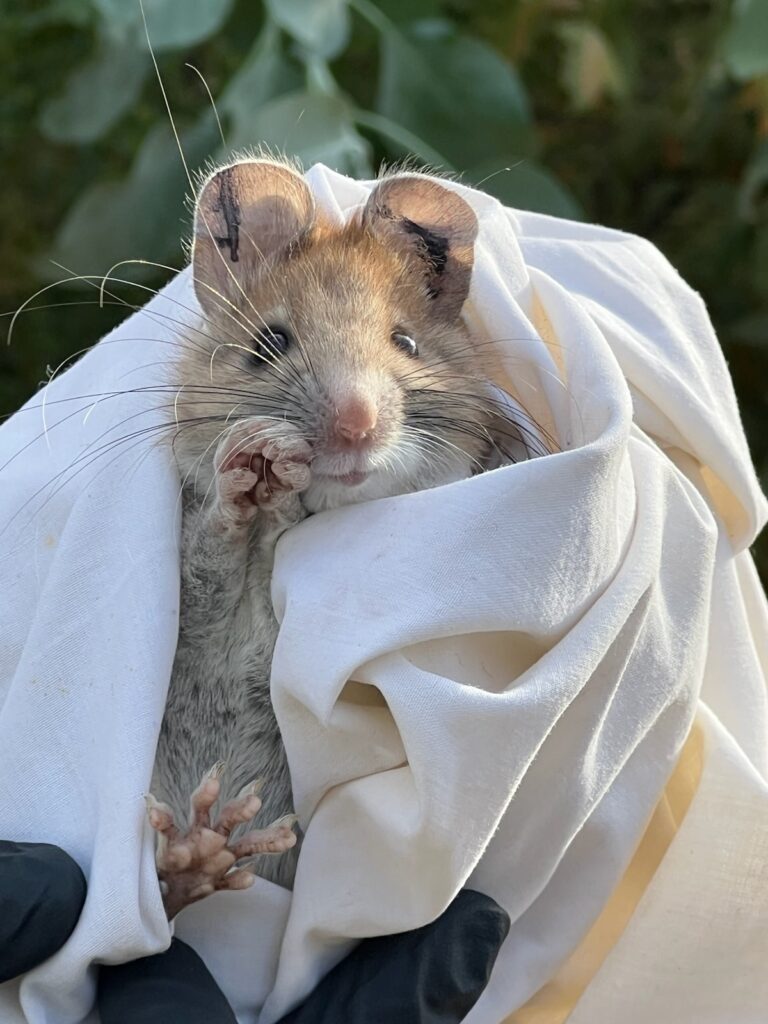
While approaching the traps, they could see something inside, and it wasn’t what they expected. In the traps were riparian woodrats, (from left to right) an adult male, an adult female, and a juvenile. Also an endangered species, these woodrats were “bycatch,” meaning they were captured while the focus was on a different species, RBRs.
A pair of riparian woodrats made their way into RBR traps last year, as well, a huge cause for celebration at River Partners and our agency partners, as it was the first time woodrats have been documented living in a restored forest. Verna said we can’t know for sure if these are the same individuals as last year, as they can only be given temporary marks on the insides of their ears with a felt pen per endangered species regulations. The most exciting part, said Verna, is the presence of a very healthy juvenile which shows us the population is stable enough to breed!
“Without getting permits in-hand and doing targeted trapping, we can’t know what the true population is, but the fact that they’re breeding is a great sign,” Verna said. “It really emphasizes the importance of collecting data, actively trapping animals, and working with a very diverse team. It’s only with multiple groups working towards united goals that can we help save these endangered species.”