
 April 15, 2026
Our restoration work throughout California brings about a wide range of results. From a circle-of-life moment and a camera-loving squirrel to one of the most important fish species in our waterways, when wildlife touch and use restored habitats, it tells us that our work is helping.
To learn more about what our staff are seeing in the field, check out the other installments of our “Eyes in the Wild” series here.
Battle Creek Ranch (Shasta County)
Senior Restoration Ecologist Corey Shake was visiting one of our newest restoration projects, the 1,721-acre Battle Creek Ranch which River Partners acquired this year, in late September to start scoping our monitoring and restoration planning efforts. He and Director of Restoration Science Michael Rogner spotted these fall-run chinook salmon making their way up Battle Creek near the ranch. As one of California’s most important salmon-bearing waterways, Battle Creek is the most important salmon and steelhead stream in the Sacramento River watershed and supports all four runs of salmon, including these fall-run Chinook salmon.
Fall-run Chinook salmon are the most abundant of the four salmon runs in the Sacramento River, California’s largest waterway. An ecological pillar, salmon have long had an intimate connection with Indigenous Tribes throughout our state. Salmon are also a keystone species in the ecosystem. When they aren’t doing well, we know a lot of things aren’t as healthy as they’ve been in the past. Salmon populations in California have declined 90% over the last two decades, forcing the federal Endangered Species Act to list fall-run salmon as a Species of Concern. Ninety percent of their historical spawning habitat has been blocked by dams, leading to crammed living conditions in small river stretches. And drought, historic heat, and low water levels are creating warmer water temperatures, which lead to an inhospitable environment for salmon egg incubation.
River Partners is undertaking several efforts to try to boost salmon numbers within the Sacramento River, from restoring salmon habitat and side channels and learning more about their migratory journeys to our organizational mission to reconnect floodplains. Our future restoration at Battle Creek is yet one more opportunity to help one of our state’s most important fish species. So, when we see this group of salmon in Battle Creek, we’re reminded that every year that passes is an opportunity that shouldn’t be missed to improve habitat conditions for salmon. The offspring of these fish will return in just 2-4 years to spawn themselves and so our quick action to improve conditions on the river will be paid back relatively quickly in numbers of adult returns. We just have to act, and act now.
Hidden Valley Ranch (Stanislaus County)
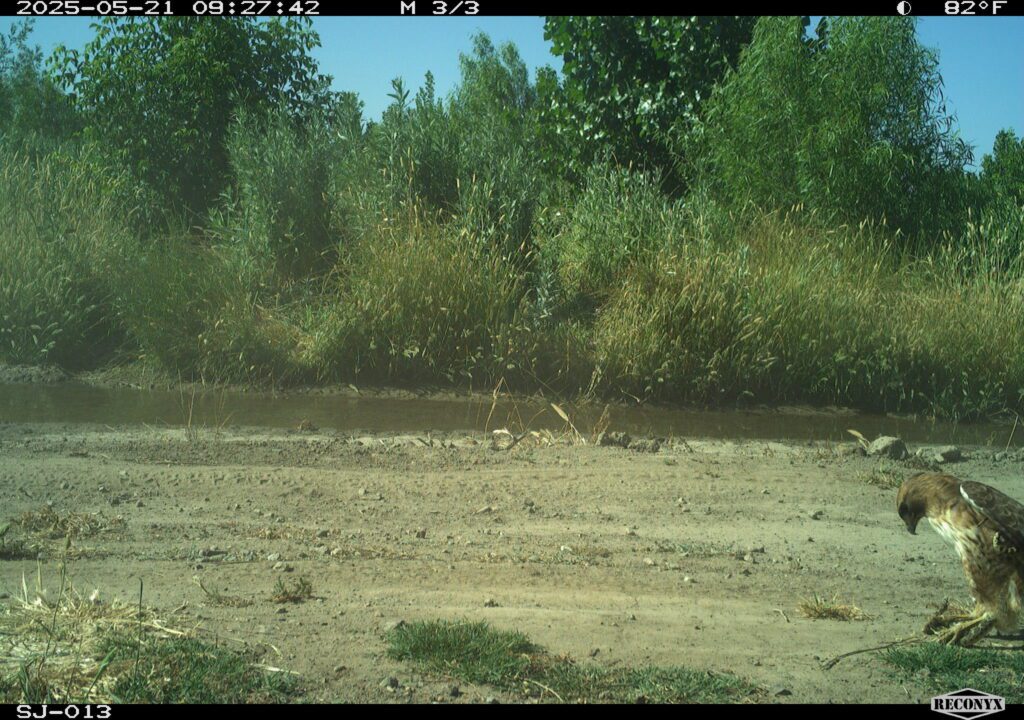

At our 350-acre restoration of Hidden Valley Ranch, a former dairy farm just west of Modesto, one of our cameras caught a red-tailed hawk capturing a gopher snake for a meal. These birds thrive in riparian corridors, restoration sites, and agricultural fields where prey density is often very high.
The red-tailed hawk is one of the San Joaquin Valley’s most dominant raptors, and certainly one of the region’s most visible daytime predators. Using the trusty sit-and-wait method, they’ll perch on a tree or pole or soar overhead using their exceptional vision to scan for movement. Red-tailed hawks are opportunistic when it comes to prey, focusing on rodents, rabbits, and, yes, snakes. In this instance, the hawk may have seen the gopher snake emerge from grass or basking out in the open.
The mechanics of red-tailed hawk kills are impressive. Once the hawk spies its prey, it quickly drops and aims to pin the snake behind its head. While powerful talons apply crushing force to control the body, it may spread its wings for balance and to shield an ensuing strike. Flying away with the snake while it’s still active could be a risky proposition, since the prey could squirm or thrash in midair and force the hawk to lose its grip. So, the hawk’s plan here is simple: Kill first, transport second. Hawks are not immune to the bites of venomous snakes, so avoiding a strike is critical. That won’t be a concern here, though—it looks like the hawk has this non-venomous snake under control. Ah, the circle of life…
Panorama Vista Preserve (Kern County)
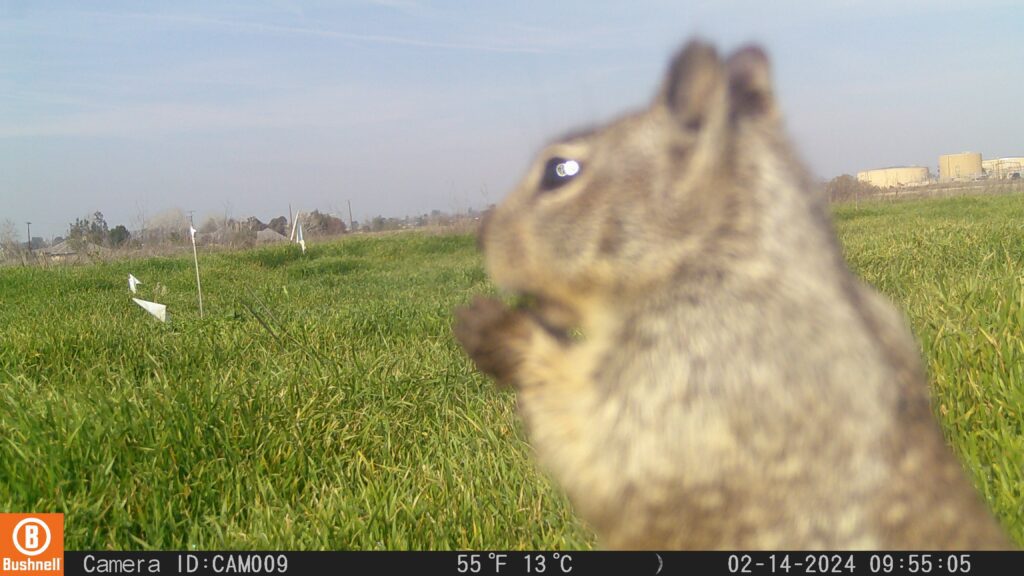
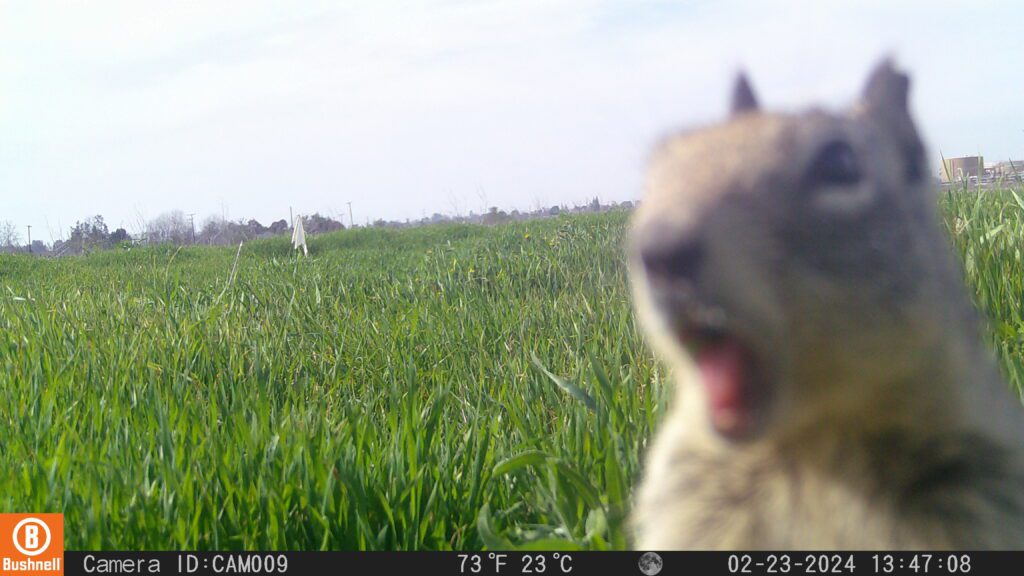
If you haven’t already met him, please meet Jerry, a California ground squirrel. He makes his home at the 935-acre Panorama Vista Preserve (PVP), restored by River Partners north of the Kern River in Bakersfield. And since we introduced Jerry on social media nearly two years ago, he’s become a beloved critter mascot at River Partners. Certainly not PVP’s only resident squirrel, he’s without a doubt the most photogenic.
Ubiquitous around California, ground squirrels are primarily herbivores and enjoy feasting on seeds, grasses, and crops, like nuts and grains. They are extensive burrowers, creating multi-entrance tunnel systems. In some parts of the state, ground squirrels have been removed, to the detriment of other rare species which would have used their burrows. To help make up for some of this lost habitat, some land managers in San Diego County are installing artificial burrows so burrowing owls can live in them. And while these systems benefit the ecosystem in some ways—aeration and mixing soil, improving water infiltration in compacted soils, and creating refugia for other species (burrowing owls, reptiles, invertebrates)—they can also negatively impact levees, irrigation banks, and restoration plantings. As a keystone prey species, they are an important part of the food web, favored by coyotes, foxes, raptors, and snakes. Interestingly, some ground squirrel populations show resistance to rattlesnake venom and will even antagonize them (would not recommend, Jerry).
Ground squirrel population numbers are strong, thanks in part to their broad habitat tolerance, high reproductive output, and burrowing ability to largely avoid environmental stress. Ground squirrels also easily integrate into human-modified landscapes.
San Joaquin National Wildlife Refuge (San Joaquin and Stanislaus Counties)
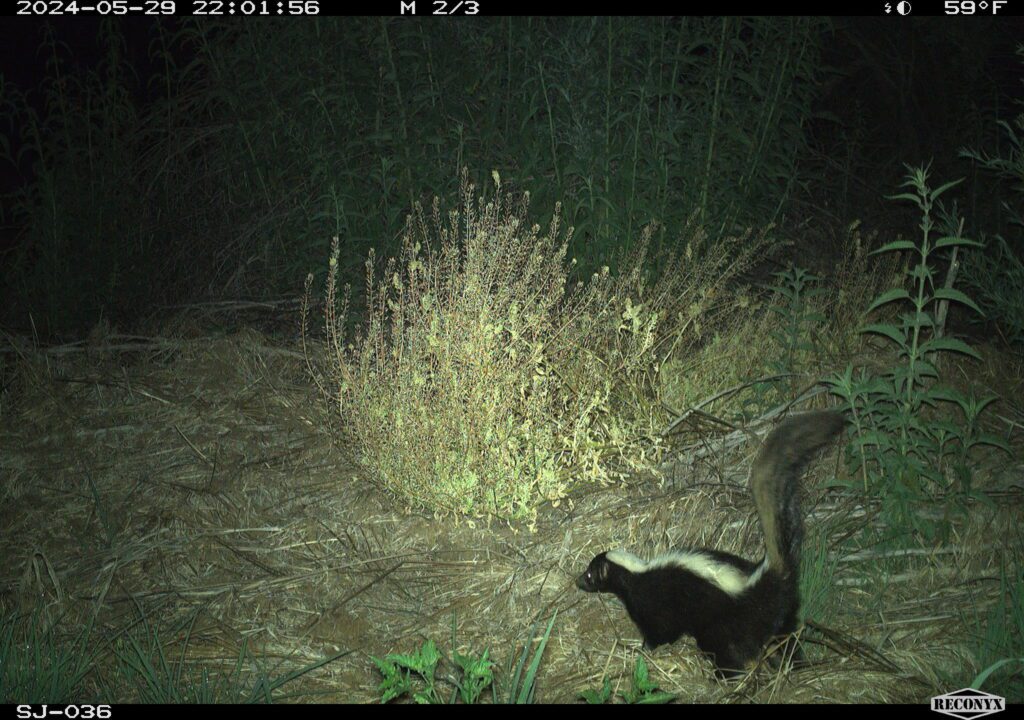
Nighttime is the best time for this striped skunk, caught on a camera trap at the 7,500-acre San Joaquin River National Wildlife Refuge, where River Partners has restored around 2,500 acres of native habitat. This little one probably loves its environment, since the Refuge checks several boxes: it requires water access, dense cover, and abundant food. The striped skunk is mostly nocturnal and can also be active at dusk. They will den in burrows (often borrowed from other animals), brush piles, and riparian thickets, as well as under sheds and decks. They love living in riparian corridors, as we can see here, but will also persist (and often thrive) in human-altered landscapes.
As early adopters of restored habitats, seeing this skunk here is a good indicator of a functional and healthy food web. Farmers like the striped skunk because they reduce pest populations, especially insects and rodents, which can damage crops, while also feasting on eggs, reptiles, and amphibians if given the chance. They’ll also help limit disease vectors by consuming carrion.
The striped skunk population is strong in California and is a textbook example of a resilient generalist species. It has a broad and available diet, it’s comfortable in diverse habitats, and has a strong predator-deterrent system. Its signature trait is, of course, a highly accurate musk spray (traveling up to 15 feet!) that’s used only as a last resort. Despite its strong numbers, localized pressures persist, including habitat loss and fragmentation, road and vehicle mortality, and trapping due to nuisance concerns.