
 November 10, 2025
Fieldwork can be a challenging job for River Partners’ science and operations staff. Planting in the summer heat, bushwhacking through heavy brush, and collecting data in stormy conditions—it’s all done in the name of restoration, ecosystem health, and thriving communities. Occasionally, though, they’ll encounter interesting wildlife and document it for the rest of us to experience. Whether its wildlife that flies or slithers, hides or makes itself comfortable, even in neighborhoods, when they show up, it means restoration works—and we’re proud to share that in this wildlife journal series.
Please check out the other installments of our “Eyes in the Wild” series here.
Colusa Unit Sacramento River Wildlife Area (Colusa County)
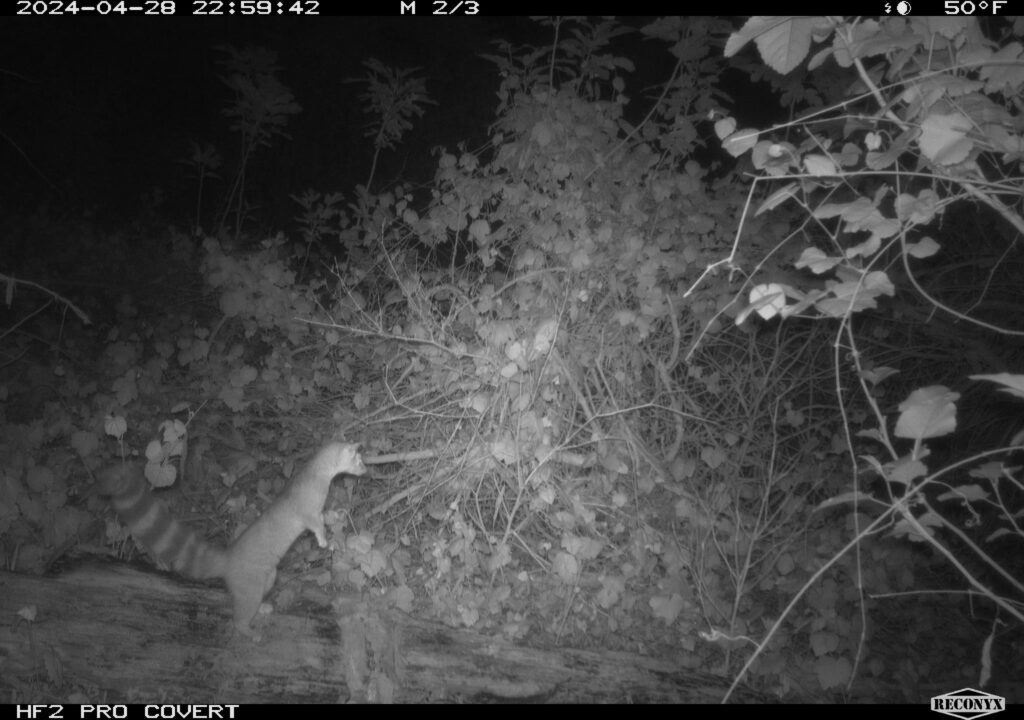
Our longstanding partnership with the California Department of Fish and Wildlife (CDFW) has meant studying wildlife at a couple dozen units along the 3,900-acre Sacramento River Wildlife Area (SRWA) in Northern California. This includes camera trap photos, like this one of a ringtail taken by a camera at the SRWA’s Colusa Unit, just north of a future River Partners restoration site near the farming town of Colusa.
Also known as “ringtail cats,” the ringtail is a small (usually weighing 1–2 pounds), elusive, and nocturnal mammal in the raccoon family found in diverse habitats from California to Mexico. They can live in diverse habitats like deserts, chaparrals, and oak woodlands, particularly near rocky areas or riparian zones, like this one in Colusa.
“Right now, habitat along the Sacramento River resembles a mosaic with fragments here and there,” said Restoration Science Ecologist April Damanti. “We are working to reconnect fragmented habitat via restoration to give species a contiguous corridor to travel in this habitat.”
The ringtail is a species of special concern and is fully protected in California due to historic over-trapping and current threats from habitat loss and fragmentation. It’s also an important omnivorous predator and prey species within its ecosystem, eating small mammals, birds, reptiles, insects, and native fruits like berries.
Grayson Riverbend Preserve (Stanislaus County)
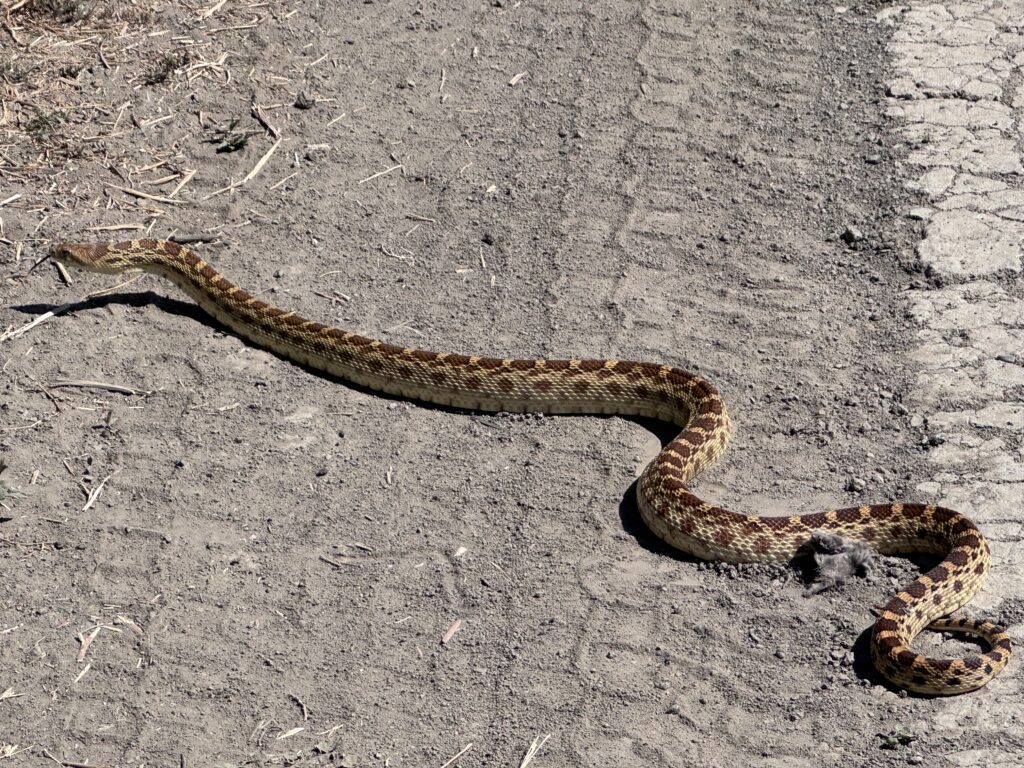
Associate Restoration Scientist Diego Garcia and his team had just finished monitoring some vegetation in the restoration fields of Grayson Riverbend Preserve, a nearly 300-acre restoration project along the San Joaquin River in Stanislaus County. Garcia was driving the team out when he noticed a snake sunbathing in the middle of the road and stopped the vehicle. Getting closer, they identified it as a gopher snake.
“It’s rare we encounter them when we’re in the field, so we got out to take a closer look,” Garcia said. “It was pretty docile, so we were able to get pretty close to it before we scared it off.”
While the non-venomous gopher snake poses no real danger to humans, they are cunning mimics and can trick predators and other wildlife when threatened. They’ll hiss and inflate their bodies to appear larger, shake their tails on loose soil or vegetation to sound like a rattlesnake’s rattle, and flatten their heads so it appears more triangular, like a venomous snake. Gopher snakes can grow to reach lengths of 7 feet and are skilled pest control, dining on rodents like mice, gophers, and ground squirrels, a benefit to farmers and homeowners. They’re plentiful in California and are considered non-threatening to humans since they’re non-venomous.
Hatmark PG&E Mitigation (Stanislaus County)
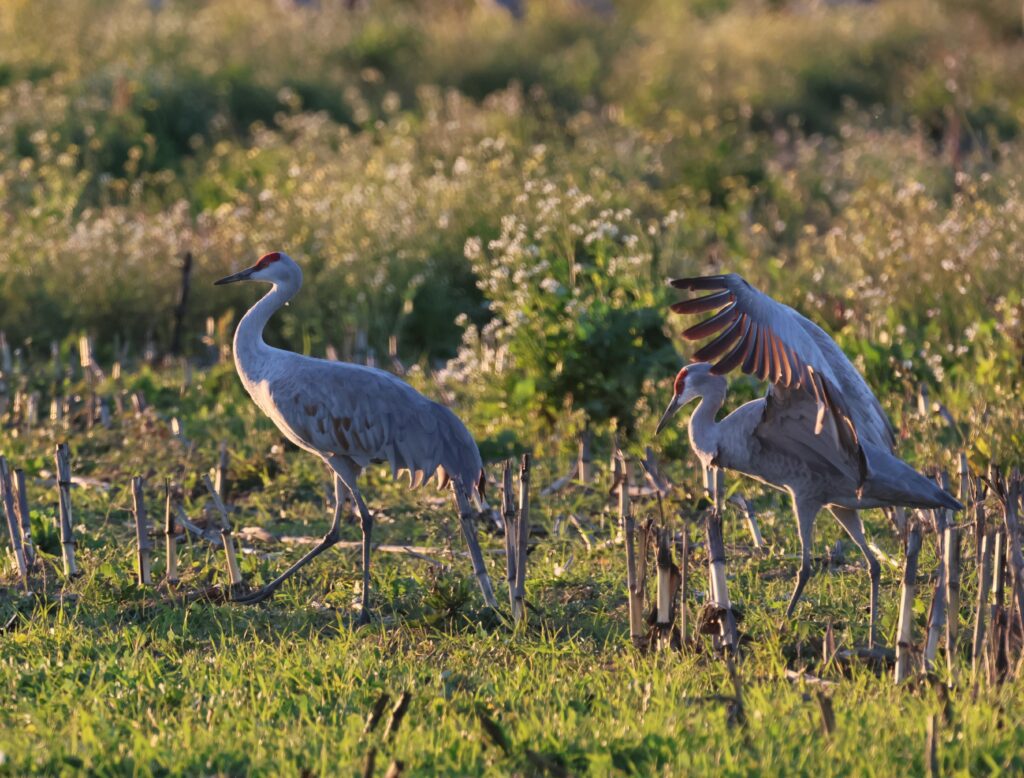
Restoration Science Ecologist Haley Mirts was conducting some pre-restoration monitoring at our 100-acre Hatmark PG&E Mitigation site, which began this month in Stanislaus County. As she made her way around the property, she snapped photos of these gorgeous sandhill cranes strolling around and making good use of the open space of what was once agricultural land supporting row crops—note the old corn stalks.
“The cranes show up to that area in big numbers since there’s lots of open fields in that area,” Mirts said. “These birds were making use of the space to dance and forage.”
This is the time of year when sandhill cranes and other migratory birds report to the wintering grounds of the Central Valley—Hatmark is a stop along the approximately 10,000-mile Pacific Flyway. It’s part of the bird’s remarkable migration from their summer breeding grounds in Alaska, Canada, and the Pacific Northwest. In the meantime, they’ll remain in the Central Valley (to forage and rest) through late February, then it’s off once again to their northern breeding grounds through mid-March. Of the two different subspecies of sandhill cranes, the greater sandhill crane (pictured) is the larger. This subspecies is listed as Threatened under the California Endangered Species Act.
San Luis National Wildlife Refuge Complex (Merced County)
On an after-work trip to the 26,800-acre San Luis National Wildlife Refuge Complex in Merced County, where River Partners is restoring approximately 275 acres over multiple areas, Associate Restoration Science Fellow August Frisk and his wife were reconnecting with nature. While at the Refuge, they caught glimpses of black-tailed deer, tule elk, and herons and egrets—as well as a handful of coyotes. When this coyote began its vocalization, Frisk caught the moment on his phone. Intelligent and social animals, they often live in family packs, which this coyote may be communicating with in this video. Of course, the vocalization could very well be to announce to nearby animals or coyote packs (or humans?) that they’re encroaching on that coyote’s territory.
The coyote is one of California’s most adaptable predators (their population numbers are very healthy) and found in virtually every ecosystem in the state, from the Central Valley to the coast, from remote locations to densely populated urban neighborhoods. The Central Valley is an ideal landscape for the coyote, with its mix of agricultural lands, protected wildlife refuges, and expanding urban development.
Its ability to maintain ecosystem balance by controlling pests is almost unrivaled, as it will prey upon small rodents like ground squirrels, gophers, and voles. Of course, because the coyote is opportunistic, it will also find unsecured garbage, pet food, as well as small family pets, if available.